

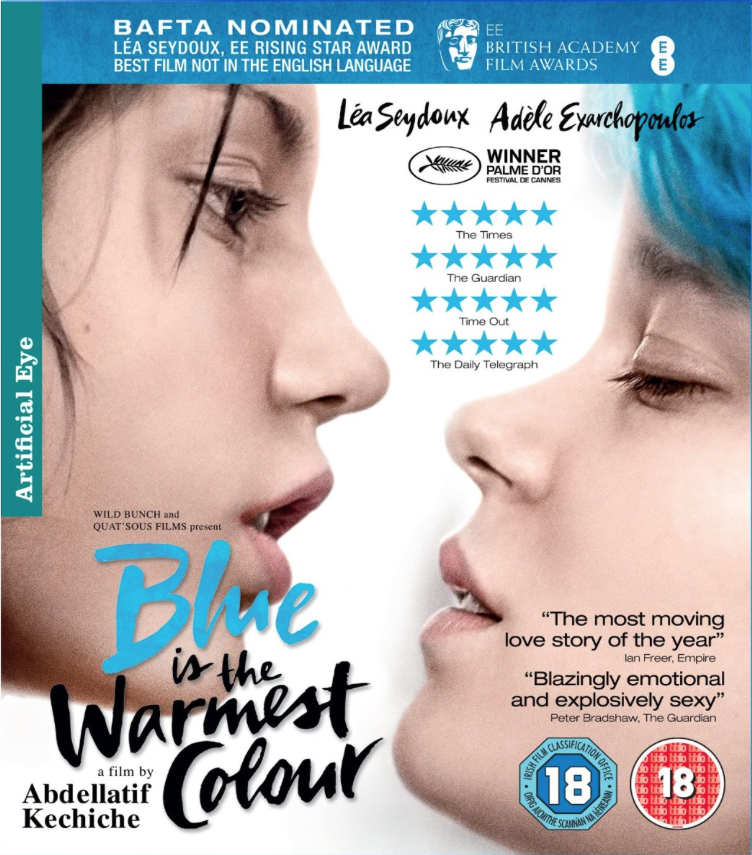
Blue Is The Warmest Colour
Artificial Eye | Abdellatif Kechiche | 2013 | France
Genre: Drama | Romance
Running Time: 180 minutes (2:59:46)
Region Code: Region B
Rating: 18
Aspect Ratio: 2.35:1 (Original Aspect Ratio)
Video: 1080p High Definition (24fps)
Codec: MPEG-4 AVC
Image: Colour
Audio: French DTS-HD Master Audio 5.1 | French LPCM 2.0
Language: French
Subtitles: English [Hardcoded]
——————————————————-
The majority of the following review is reproduced from the original London Film Festival review of the film (posted: October 2013). After a re-watch, most of the review is still valid.
——————————————————-
One of the most eagerly anticipated home entertainment releases of early 2014, Tunisian-born French director Abdellatif Kechiche’s bold, expansive and incredibly audacious film truly proves itself as the deserving winner of the Palme d’Or at the 2013 Cannes Film Festival, marking the first ever time in which the prize was officially awarded to the two lead actresses as well as the director.
Loosely adapted from Julie Maroh’s multi-award-winning 2010 graphic novel – originally released as ‘Blue Angel’, and later republished under the title ‘Le bleu est une couleur chaude’ (‘Blue is the Warmest Colour’) – it is interesting to note that Kechiche’s glorious adaptation, featuring a screenplay by Ghalia Lacroix, was released in its native France under the title ‘La Vie d’Adèle – Chapitres 1 & 2’ (‘The Life of Adèle – Chapters 1 & 2′), which, given the central plotline, is a significantly more appropriate title than its subsequent English transalation, but is perhaps not quite as visual or as symbolic as the title by which it is now known.
Starting as it means to go on, the film unusually opens at quite a leisurely place, following 15-year old Adèle’s journey to school, establishing her monotonous daily school routine and introducing her foul-mouthed adolescent group of friends.
Though focusing hard on her studies, whilst cautiously entering a tentative relationship with her admiring male classmate, Thomas (Jérémie Laheurte), Adèle finds herself increasingly infatuated with the blue-haired tomboy, Emma (Léa Seydoux), whom she first glimpses whilst crossing the road one day, however, aside from this brief cameo, Emma does not actually appear again until around one hour into the film.
As Adèle grows increasingly more curious over her new romantic leanings she finds herself wandering through the city’s gay bars where she eventually comes face to face with the older, fine arts college student, Emma, and as their friendship begins to grow a passionate romantic relationship soon begins to develop.
Spanning several years in Adèle’s life from naïve young girl to mature, confident woman, the film charts the highs and lows in her fraught relationship with Emma, ultimately charting her complex journey towards adulthood.
The now famous sex scenes are frequent, lengthy (some up to around 10-minutes in length) and extremely explicit, but incredibly graphic though they are, they are never done in a sordid or uncomfortable way, they are intimate, erotic and ultimately very intense.
The screenplay, thankfully free from all the familiar clichés associated with homosexuality and conventional, mainstream romance films, is so well thought out and effectively constructed that the dialogue, at times moving, sharp, sarcastic and wildly satirical feels so authentic and is so naturally delivered that it only goes towards enhancing the quality of the overall piece.
The film ultimately rests on the performances of its central figures, and although Léa Seydoux is superb as the seductive Emma, relative newcomer, Adèle Exarchopoulos (18-years of age at the time of filming) delivers what is arguably the performance of the year as the troubled young Adèle. Exarchopoulos’ complex, multi-layered performance is so utterly complete and authentic, fused throughout with an intelligence, a profound sensitivity and a convincing character development that is a joy to watch as the complexities of the film unfold.
Though Sofian El Fani’s mostly close up and often soft focus, digitally-shot cinematography proves very immersive, it can sometimes feel ever so slightly too close, however it ultimately works in favour of the piece as it adds to the intensity and accentuates every intricate detail of the performers’ expressions, agitations and emotions.
Beautifully composed, visually stunning, deeply moving, very honest and utterly unmissable.
——————————————————-
Blue is the Warmest Colour was voted our #1 film of 2013 and this re-watch only further confirms our decision! Click Here to view the full list.
——————————————————-
Presented in the original aspect ratio of 2.35:1, Artificial Eye’s MPEG-4 AVC encoded 1080p High Definition presentation is quite outstanding, boasting exceptional levels of rich, warm colour, crisp clarity and deep contrast. As previously mentioned, the film relies heavily on close up images, all of which appear incredibly sharp throughout the presentation, which continually superb levels of final detail and image depth.
Both the French DTS-HD Master Audio 5.1 and LPCM 2.0 audio mixes prove crisp, clean and stable throughout. There is no original soundtrack as such, instead prominently featuring or making use of ambience and natural sound effects, which again are beautifully presented across the surround channels (on the 5.1 MA mix).
——————————————————-
Special Features:
UK Theatrical Trailer (0:01:53)
Deleted Scenes (0:08:13)
Interview with Adele Exarchopoulos (0:07:34)
Interview with Abdellatif Kechiche (0:09:03)
——————————————————-
Release Date: 17 March 2014
Pre-order Blu-ray Now (click image to buy):


Pre-order DVD Now (click image to buy):


——————————————————-
[youtube id=”jCKHZu36BoQ” width=”600″ height=”350″]
——————————————————-


[…] ← Previous Post […]