

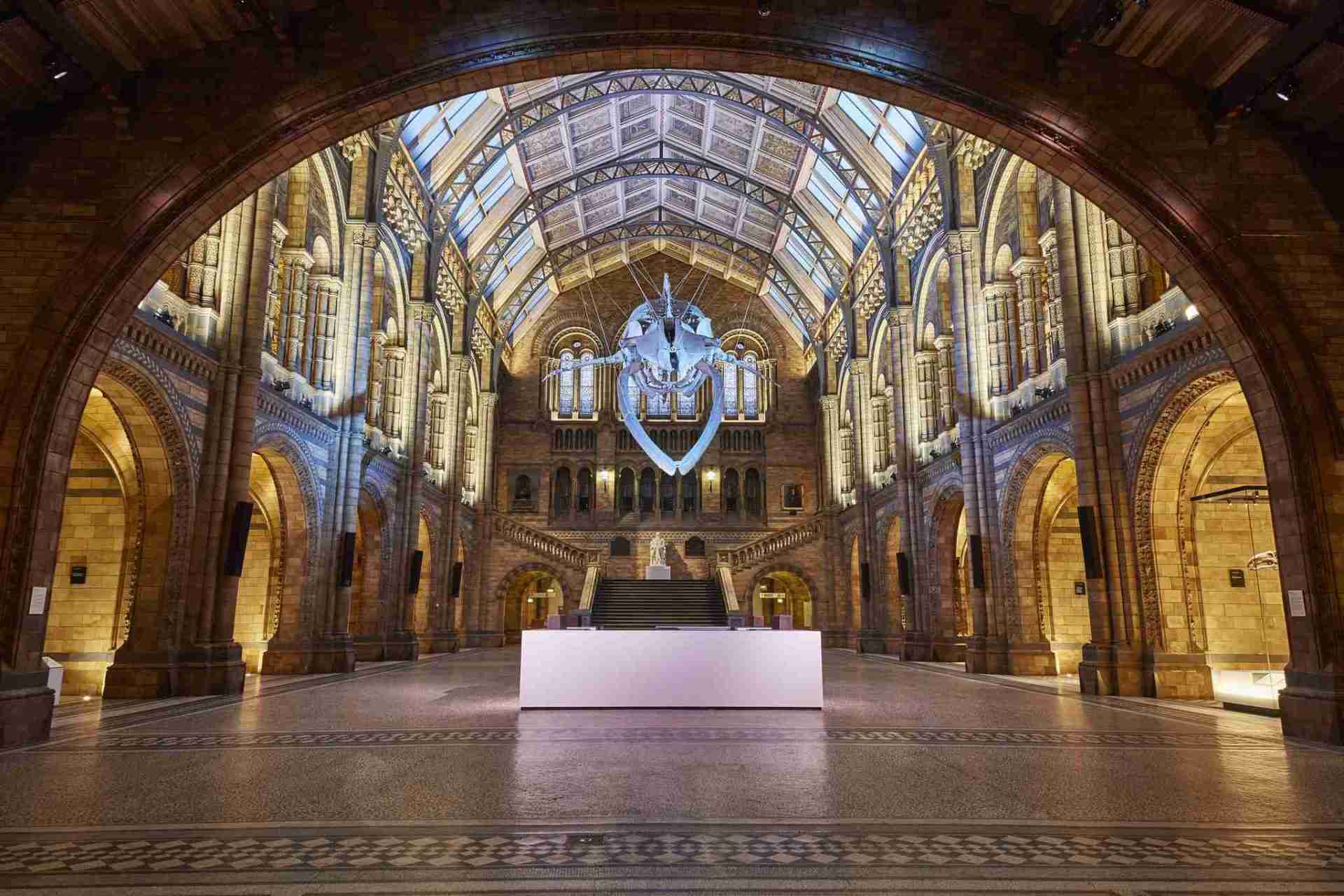
Images © Trustees of NHM
Following a star-studded gala launch last month, attended by the Natural History Museum‘s Patron, HRH The Duchess of Cambridge, and Sir David Attenborough, the reimagined Hintze Hall has now opened to the public, with Hope the blue whale firmly taking centre stage.
Blue whales were hunted to the brink of extinction in the twentieth century, but were also one of the first species that humans decided to save on a global scale. Named by the museum as a symbol of humanity’s power to shape a sustainable future, the stunning 25.2 metre real blue whale skeleton is now suspended from the Hintze Hall ceiling, giving visitors the opportunity to walk underneath the largest creature ever to have lived.

She will be joined in Hintze Hall by hundreds of new specimens, chosen to celebrate the wonder and beauty of the natural world, from the origins of the universe, to the story of evolution and diversity in the world today. Ten star specimens will be arranged in the ground floor alcoves – known as Wonder Bays – including a 4.5-billion-year-old meteorite, a Mantellisaurus dinosaur skeleton, giraffes and a blue marlin.
The skeleton is from a whale that became stranded in 1891 in Wexford Harbour, Ireland, 10 years after the Museum opened in South Kensington. It was bought by the Museum and first went on display in the Mammal Hall in 1934, where it was suspended above a life-size model of a blue whale. Curators, conservation teams and engineers have been working on the blue whale skeleton for months – mostly in an off-site warehouse due to its enormous size – cleaning and preparing it for its new home in Hintze Hall.
For more information on the Natural History Museum, and to book tickets for current exhibitions, please Click Here.

