

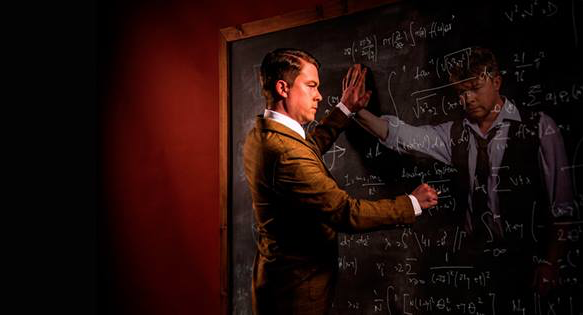
BREAKING THE CODE
Royal Exchange Theatre, Manchester
Until Saturday 19th November, 2016
Widely acknowledged as the father of artificial intelligence and theoretical computer science, Alan Turning is without doubt of the most important and influential figures in modern British history.
Stationed at Britain’s codebreaking centre, Bletchley Park during the Second World War, Turing’s work for the Government Code and Cypher School (GCCS) was instrumental in cracking the German’s enciphered Enigma Code messages, enabling the Allied Forces to defeat the Nazis; an achievement estimated to have shortened the war by over two years and saved over fourteen million lives.
Following the war efforts, Turing moved to the University of Manchester and began developing his pioneering Turing Machine, the mathematical model for the general purpose computer, though the revelation of his homosexuality, subsequent prosecution for gross indecency in 1952 and treatment with chemical castration (compulsory for his probation from prison) unfortunately sullied his towering achievements.
Through a series of intertwining snapshots, Hugh Whitemore’s beautiful and heartbreaking 1986 play juxtaposes the glory of his genius and heroism during the war with the cruel neglect, public humiliation and betrayal he faced in his later years.
Given Turing’s renown within Manchester, director Robert Hastie’s searing and impeccably paced new production feels particularly poignant here, playing out just minutes away from some of the locations referenced in the play. Ben Stones’ effective and unintrusive minimalist design uses flown LED strip lights to establish and outline the different rooms (a visual metaphor for Turing’s personal confinement), further complemented by Richard Howell’s clever lighting design and a piano soundtrack from sound designer Emma Laxton, using stripped back versions of Radiohead song introductions to the link the scenes.
Daniel Rigby is outstanding in the colossal role of Turing. Shuffling about uneasily through the various scenarios, Rigby’s faultless perfomance brilliantly contrasts the awkwardness and naivety of his personal life with the more extrovert charisma seen in his professional life, demonstrated through a series of lengthy and incredibly complex monologues that highlight both Turing’s brilliance and Rigby’s skill as a great actor.
In a fine ensemble, there is strong support from Geraldine Alexander as Turing’s mother Sara, Natalie Dew as Turing’s Bletchley co-worker Pat Green (a fictional character based on the real-life cryptanalyst and numismatist Joan Clarke), Phil Cheadle as Mick Ross (the duty-bound detective in charge of Turing’s case), Mark Oosterveen as ‘John Smith’ (the enigmatic Man from the Ministry), Harry Egan as Ron Miller (the young man at the centre of Turing’s affair), Raad Rawi as Dilly Knox (the eccentric Bletchley Park recruiting manager) and Dimitri Gripari in the dual roles of Turing’s childhood friend Christopher Morcom and his Greek lover Nikos.
Following the success of The Imitation Game, many have stated that the subject matter is now rather well-worn territory, but this marks the first major revival of the play for 30 years, and it is an extraordinary and deeply moving tale that should be widely told and never forgotten. There is a reason Winston Churchill affirmed that “Turing made the single biggest contribution to the Allied victory in the war against Nazi Germany and its Axis partners“.
Running Time: 2 hours and 30 minutes (approx.), including one 20-minute interval.
Final Performance at The Royal Exchange Theatre: Saturday 19th November, 2016
For more information, and to book tickets, please Click Here.
[youtube id=”Wb8PC-y1mPE” width=”600″ height=”350″]

