

THE IMITATION GAME
A Film By Morten Tyldum
To own on Blu-ray, DVD & download from 9 March 2015
One of the cinematic events of 2014 becomes the first essential home entertainment release of 2015 as THE IMITATION GAME – beloved by critics and audiences alike – arrives on Blu-ray, DVD and digital platforms on 9th March 2015, courtesy of STUDIOCANAL.
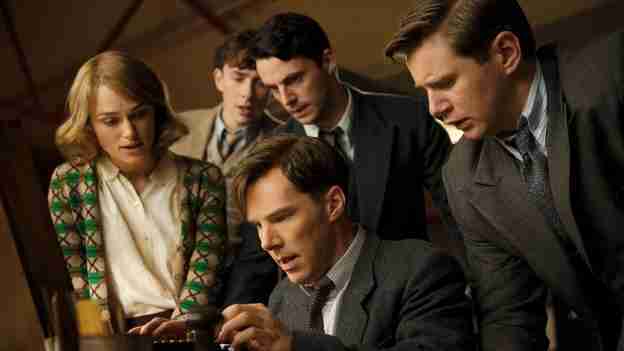
Based on the real life story of legendary cryptanalyst Alan Turing, THE IMITATION GAME portrays the nail-biting race against time by Turing and his brilliant team of code-breakers, endorsed by Churchill himself, at Britain’s top-secret Government Code & Cypher School at Bletchley Park during the darkest days of World War II. The film spans the key periods of Turing’s life, from his unhappy teenage years at boarding school and the triumph of his secret wartime work on the revolutionary electro-mechanical ‘Bombe’, which was capable of breaking 3,000 Enigma-generated naval codes a day, to the tragedy of his post-war decline following his conviction for a now outdated criminal offence. A complicated and troubled man, whose contributions and genius significantly shortened the war, saving thousands of lives, Turing may have been the eventual victim of an unenlightened British Establishment, but his work and legacy live on…
Starring Academy, BAFTA and Golden Globe nominee Benedict Cumberbatch (Star Trek: Into Darkness, TV’s Sherlock) as Turing, Academy, BAFTA and Golden Globe nominee Keira Knightley (Begin Again, Atonement) as his confidante and equal, Joan Clarke, and featuring supporting turns from Matthew Goode (Stoker, Watchmen), Mark Strong (Tinker, Tailor, Soldier Spy, Welcome To The Punch), Rory Kinnear (Skyfall, TV’s Penny Dreadful) and Charles Dance (TV’s Game Of Thrones, Gosford Park), THE IMITATION GAME is at once a searing piece of British drama, a brilliantly taut thriller and a posthumous honour to arguably one of Britain’s most important, most brilliant men.
——————————————
[youtube id=”j2jRs4EAvWM” width=”600″ height=”350″]
——————————————
World War II and Technology:
The story of Alan Turing and his invention of the first ever computer came to the silver screen in 2014 in the moving biopic THE IMITATION GAME. As the film arrives on Blu-ray and DVD from 9th March 2015, courtesy of STUDIOCANAL, we examine some of the other outstanding war-time technological inventions and advances, and look at how their uses have changed since the war.
The Original Computer
2014 blockbuster THE IMITATION GAME tells the life story of Alan Turing, the mathematician and cryptanalyst who worked for the Government Code and Cypher School (GC&CS) at Bletchley Park (Britain’s code-breaking centre) during the Second World War. For a time he led Hut 8, the section responsible for German naval cryptanalysis and was responsible for creating the Turing Machine, which decrypted the “unbreakable” German Enigma code. The role of the German Enigma machine was to encode and decode encrypted messages to its troops that the Allies would not be able to read. Turing’s machine served as an idealized model for mathematical calculation to decode the encrypted German messages. Turing’s machine was pivotal in cracking intercepted encoded messages and enabled the Allies to defeat the Nazis in many crucial engagements, including the Battle of the Atlantic. It is said by some historians that Turing’s work at Bletchley Park shortened the war by two to four years and saved approximately fourteen million to twelve million lives. The later model of computation that Turing called his ‘universal machine’ is considered by some to have been the fundamental theoretical breakthrough that led to the notion of the stored-program computer. Turing’s machine was, in essence, the invention of the modern computer.
Radio Navigation
Before the invention of radio navigation, both the Allies and Axis struggled to accurately direct their military aircrafts in blind bombing runs. The introduction of Gee-H, Oboe and GEE systems gave both forces’ aircrafts increased accuracy and safety when flying in tough conditions. LORAN, the successor to the original navigational system GEE, was used for commercial aircraft navigation until the recent introduction of GPS. However, there is now an argument that LORAN should be re-introduced on commercial and military aircraft as a failsafe for potential GPS failures.
The Jerrycan
One of the most important factors in a successful war strategy is the ability to transport resources quickly and effectively to and from the front line. In World War II, the nations that were able to maximize their efficiency and provide a regular supply of resources to the front line were most successful at equipping their troops and preparing them for battle. Transporting liquid, for example, was vital. During World War II, the Germans perfected the design of the jerrycan in order to transport vast amounts of water and fuel to their soldiers. The German design strengthened the structure with the cross shape, maximised the contents of the can and added the innovative handles that permitted soldiers to carry 2 of them in each hand. Before these innovations, fuel containers used to be impractical and rudimentary. These days, the jerrycan is still used to carry fuels, but it has also been adapted into light-weight designs to carry smaller volumes of liquid, like the plastic milk bottle.
Synthetic Rubber and Synthetic Oil
Synthetic oil was first introduced by German scientists in order to account for the extreme shortage of its natural counterpart. In World War II, polyethylene oils were utilized in powering the infamous Luftwaffe air force which caused devastating destruction to the Allies. Synthetic rubber was invented in the US shortly after. The Allied Forces needed synthetic rubber because the Axis controlled the vast majority of natural rubber suppliers by the America scientist Waldo Semon. The need for synthetic resources became vital in World War II, a time when the continent of Europe was divided and resources were tactically withheld and distributed.
The Pressurised Cabin
Pre-war aircraft pilots found it extremely difficult to travel at high altitudes due to the freezing temperatures, high pressures and lack of oxygen. The solution utilized before the war was a simple oxygen mask, which needless to say, failed numerous times. In 1943 the US introduced the pressurised air cabin, a breakthrough invention that allowed pilots to travel safely at high altitudes and revolutionised air transportation forever more. Pressurised air cabins are still used on commercial airlines today, allowing for safe air travel around the globe.
Atomic Power
When scientists first realized the potential of atomic power, it was angled towards the creation of weapons of mass destruction. President Franklin D. Roosevelt’s Manhattan project was successful in developing the world’s first atomic bombs. His successor, Harry Truman, was the first to actually use atomic bombs, destroying the Japanese cities of Hiroshima and Nagasaki, in effect ending the war. In the following 49 years the USA and USSR embarked on an intense and extremely expensive Cold War arms race, wherein they competed in developing the most destructive nuclear weapons. Whilst there are still contentious issues surrounding nuclear weapons in today’s world, much legislation has been made to prevent their use and development. In the modern world atomic power is mostly utilised as a one of the cheapest sources of electricity, with 435 nuclear power reactors in operation across 31 countries. Despite this, the safety and environmental influence of nuclear power remains a concerning issue.
——————————————
Available Now
Buy Blu-ray Now (click image to buy):


Buy DVD Now (click image to buy):


——————————————
To celebrate, we have 2 x DVD copies of the film to give away courtesy of our friends at Studiocanal UK.
To enter, fill out the following form with ‘Turing’ in the subject line, including your full name, address and contact number.
(Due to some competition entry issues from forum click throughs, please ensure you refresh this page before completing the form.)
[contact-form][contact-field label=’Name’ type=’name’ required=’1’/][contact-field label=’Email’ type=’email’ required=’1’/][contact-field label=’Subject’ type=’text’ required=’1’/][contact-field label=’Address’ type=’textarea’ required=’1’/][contact-field label=’Contact Number’ type=’text’ required=’1’/][/contact-form]
Competition closes on Wednesday 18th March, 2015
Winners will be notified by phone / email
Best of luck!
———————————————————–
TERMS & CONDITIONS
Please Note: Automated/bulk entries and entries from third parties are not permitted and will be deleted immediately!
– The winner(s) will be drawn at random from all the correct entries, and only they will be contacted personally. Prize must be taken as stated and cannot be deferred. There will be no cash alternatives.
– The Arts Shelf does not accept any responsibility for late or lost entries due to the Internet or email problems. Proof of sending is not proof of receipt. Entrants must supply full details as required on the competition page, and comply with all rules to be eligible for the prizes.
– No responsibility is accepted for ineligible entries or entries made fraudulently.
– The Arts Shelf reserves the right to cancel the competition at any stage, if deemed necessary in its opinion, and if circumstances arise outside of its control.
– Entrants will be deemed to have accepted these rules and to agree to be bound by them when entering this competition.

