

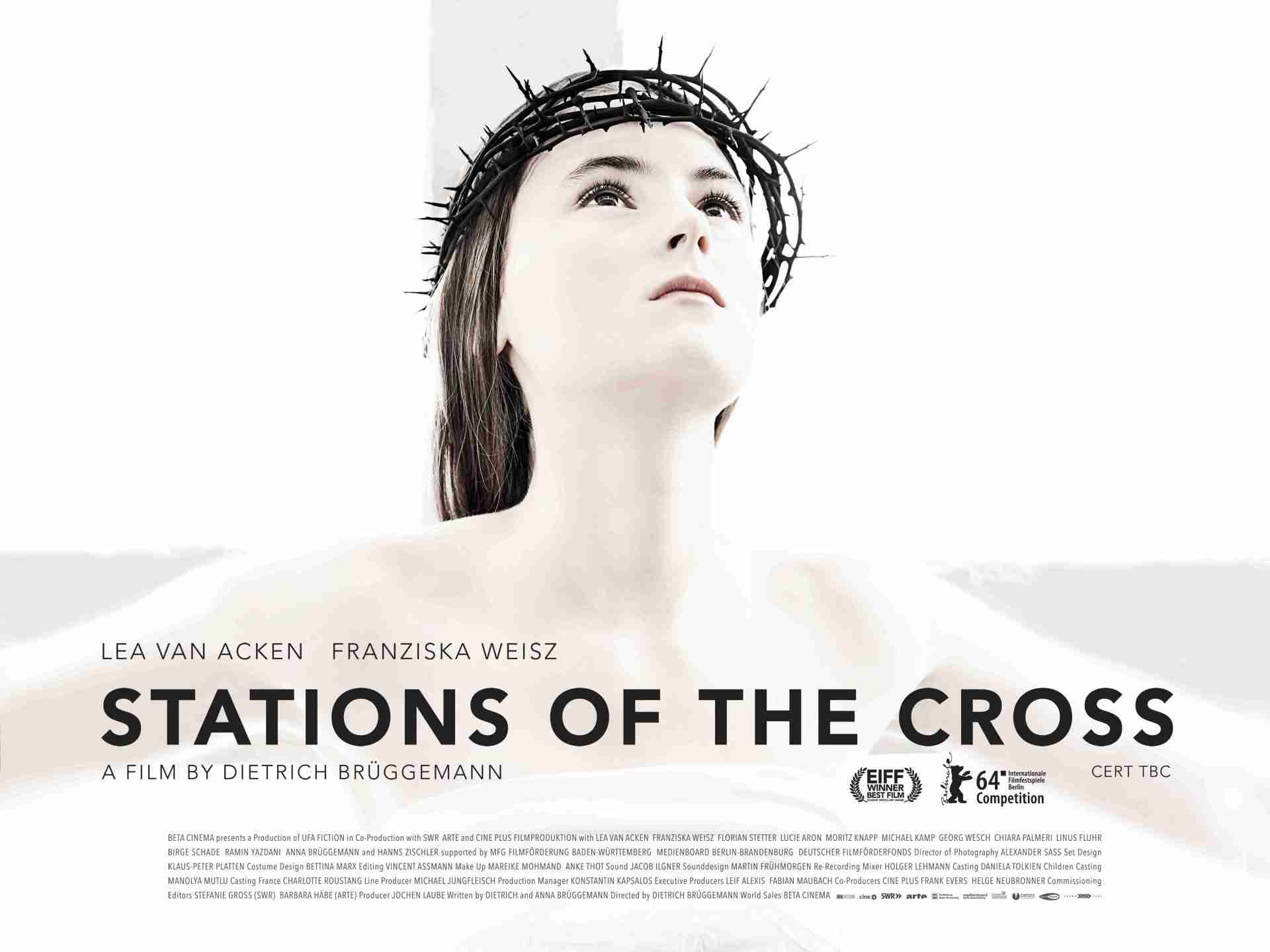
STATIONS OF THE CROSS
Directed by Dietrich Brüggemann
Starring Lea van Acken, Franziska Weisz, Florian Stetter, Hanns Zischler and Lucie Aron
STATIONS OF THE CROSS is an indictment and, at the same time, the legend of a saint.
It’s a story of religion, devotion and radical faith, and the film itself comes along just as radical as the subject matter, telling the story in only 14 fixed-angle long shots, allowing the viewer to contemplate the interactions on screen in an entirely different way than in a traditional film.
————————————-
Maria is 14 years old. Her family is part of a fundamentalist Catholic community.
Maria lives her everyday life in the modern world, yet her heart belongs to Jesus.
She wants to follow him, to become a saint and go to heaven – just like all those holy children she’s always been told about.
So Maria goes through 14 stations, just like Jesus did on his path to Golgatha, and reaches her goal in the end.
Not even Christian, a boy she meets at school, can stop her, even if in another world, they might have become friends, or even lovers.
Left behind is a broken family that finds comfort in faith, and the question if all these events were really so inevitable.
————————————-
[youtube id=”3c_QVh933fc” width=”600″ height=”350″]
————————————-
THE STATIONS OF THE CROSS
The Stations of the Cross illustrate the path taken by Jesus Christ from his death sentence proclaimed by the Roman governor of Palestine Pontius Pilate up to his entombment. The tradition of “doing the stations of the cross” or of praying them, exists in the Catholic and Anglican churches. It was introduced in the 14th century by Christians in Jerusalem who wanted to follow Christ’s Way of the Cross along the “Via Dolorosa” with a cross on their shoulders to show that they had accepted Jesus’ invitation: “Whoever wishes to be my disciple must be self-denying, and must take up his cross and follow me.” (Gospel of St. Mark, 8,34)
The Stations of the Cross then came to Europe through the returning crusaders. At the beginning, there were only seven stations, which were called the seven falls of Christ, or the seven ways of Jesus. It was not until the 17th and 18th centuries that the two Franciscan monks Antonius Daza and Leonard von Porto Maurizio presumably gave the Stations of the Cross their present form with 14 stations, which then spread throughout the Christian world.
The Stations of the Cross can be walked at any time, alone or in a group. Such stations are found in every Catholic church, sometimes outdoors as well, whereby in mountainous areas the path often ascends so as to symbolically convey Jesus’ arduous ascent to Mount Golgotha, where he was crucified. The walking of the Way of the Cross can also be understood as a devotion that is a form of meditation, especially when done alone.
Station of the Cross devotions are held above all during Lent, and especially on the day of Christ’s death, Good Friday. The best-known devotion of this kind is the one on the Via Dolorosa in Jerusalem. This road probably does not fully correspond to the path that Jesus took. The 14 Stations of the Cross depict not only occurrences mentioned in the Gospels, but were also supplemented with the three stations in which Jesus fell to the ground under the crushing weight of the cross; the meeting with his mother; and the meeting with Veronica, who gave him a cloth with which he cleaned his face of sweat and blood. This face-cloth later gained great fame as an object of the cult, similarly to the Shroud of Turin which was said to show Jesus’ face.
In 1731 Pope Clement XII recognized this form of the Way of the Cross as part of the religious canon. Whoever walked it obtained the promise of the remission of various sins. When the Spanish monk Estanislao died at the age of 24 in March 1927, he left a God-given list of promises which would fulfill themselves for the benefit of everyone who would devotedly pray the Stations of the Cross. Among them are listening to the prayers spoken on the Way of the Cross, as well as the forgiving of all sins.
The Stations of the Cross are important to Catholics not only because they assert that Jesus was a man [“Ecce homo!” – “Behold the man”, John 19,5] who had to endure many sufferings, from being arrested without reason, to accusations of treason, torture, physical abuse and up to an unimaginably painful death, but also because the symbol of Christianity stands in the forefront: the cross which each of us carries, but which also brings redemption when one professes one’s belief in it. In Jesus’ day, death on the cross was not only a particularly gruesome death, but above all a disgrace, which others wished upon those they considered the lowliest among men.
————————————-
The 14 Stations of the Cross:
1. Jesus is condemned to death
2. Jesus takes up the cross on his shoulders
3. Jesus falls for the first time
4. Jesus meets his mother
5. Simon of Cyrene helps Jesus carry the cross
6. Veronica wipes the face of Jesus
7. Jesus falls for the second time
8. Jesus meets the women of Jerusalem
9. Jesus falls for the third time
10. Jesus’ clothes are taken away
11. Jesus is nailed to the cross
12. Jesus dies on the cross
13. Jesus is taken down from the cross and placed in his Mother’s lap
14. The holy body of Jesus is laid in the tomb
————————————-
Produced by UFA Fiction Ludwigsburg in co-production with SWR, arte and Cine Plus
Supported by Medienboard Berlin-Brandenburg, MFG Filmförderung, Deutscher Filmförderfonds
————————————-
Stations of the Cross is currently playing in selected cinemas across the UK

