

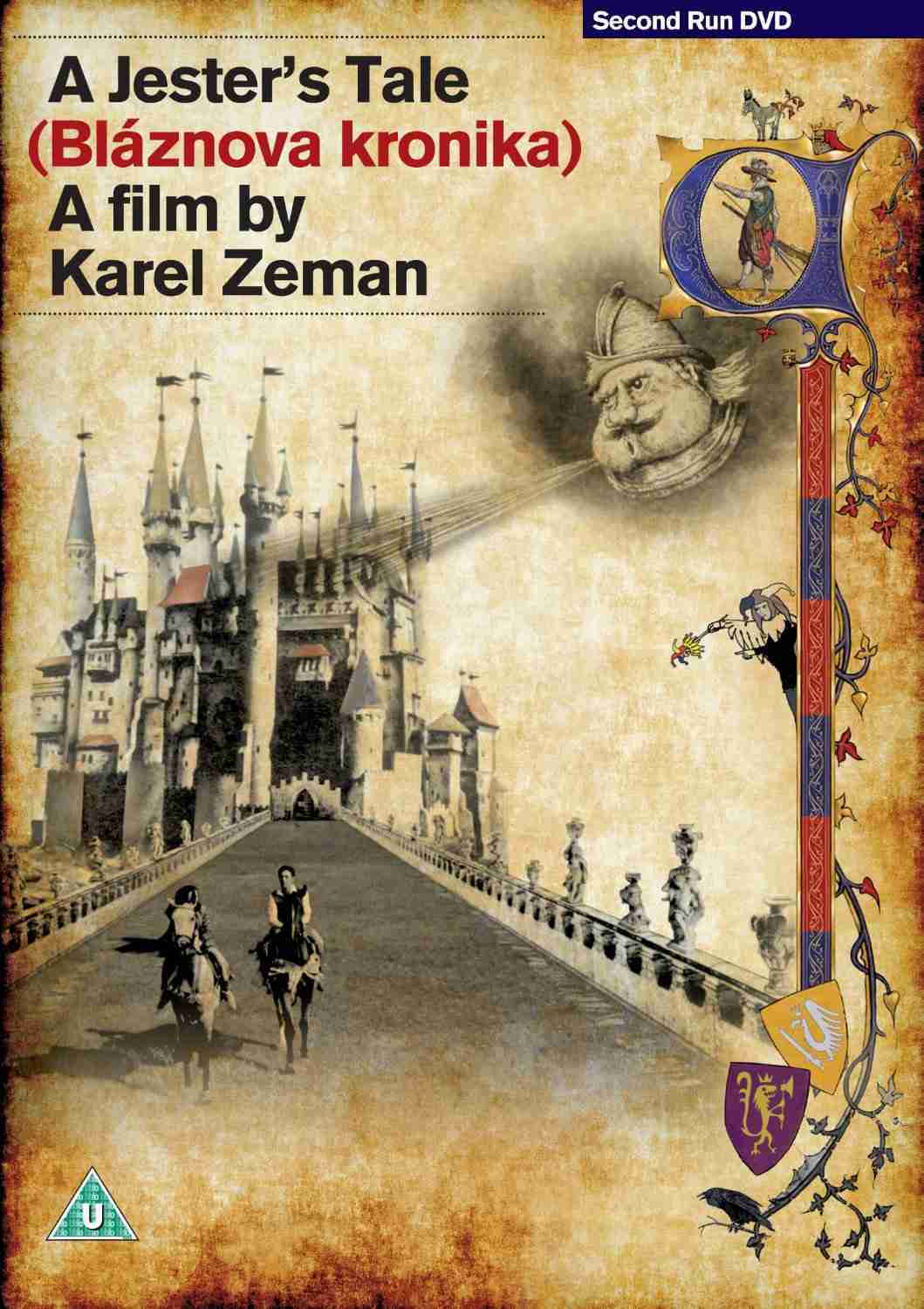
A Jester’s Tale [Bláznova kronika]
Director: Karel Zeman
Studio: Filmové studio Barrandov
Distributor: Second Run
Year: 1964
Country: Czechoslovakia
Genre: Fantasy | Animation | Historical
Running Time: 81 mins
Region Code: 0 – PAL
Certificate: U
Aspect Ratio: 1.85:1 (Original Aspect Ratio)
Format: DVD9
Image: Black and White
Language: Czech
Subtitles: Optional English (On/Off)
——————————————————-
Czech animator Karel Zeman has left a large, exquisitely engraved imprint on the world of fantasy cinema, name-checked by a superstar roll-call of film fabulists from Ray Harryhausen to Tim Burton and Terry Gilliam. Yet Zeman remains a better-kept secret internationally than compatriot magicians of motion Jiří Trnka and Jan Švankmajer. This relative neglect of Zeman’s work is perplexing for a filmmaker both dazzlingly original in his near-avant-garde blend of tricks and highly accessible in his love of old-fashioned adventure.
Zeman’s 1964 feature A Jester’s Tale now makes an especially welcome home-video debut in the Anglophone world, thanks to ever-exciting DVD label Second Run. Coming after the better-known The Fabulous Baron Munchausen (1961) (itself unavailable on British DVD), A Jester’s Tale belongs to the cycle of films for which Zeman prepared his most celebrated technical brew. Real actors are combined with stylised matte paintings that evoke both antique illustrations and monumental and fantastic sets, while stop-motion and cut-outs add to a collage-like but entirely seamless whole. These fictions are wildly visionary yet enamoured of bygone eras, brave old worlds constructed with Mélièsian homemade ingenuity.
Zeman often drew on the treasures of literary fantasy, notably Jules Verne, but A Jester’s Tale is an original, scripted by Zeman and Czech New Wave writer-director Pavel Juráček (himself a long undersung talent). Set amid the carnage of the Thirty Years’ War, the film charts the fortunes of a ploughboy who, forcibly conscripted and literally ducking slaughter, picks out a path of survival alongside an earthy, acquisitive older comrade. Kidnap and imprisonment in an aristocratic court bring potential marital as well as martial entanglements.
Appropriately the story is framed as the ink-spotted historical chronicle of a jester and ‘madman’: this is a tale that, if not itself signifying nothing, wryly addresses the senselessness of war and the meaninglessness of its outcomes, the distinction between competing sides here little more than a difference of insignia. Full of jibes against martial cant and the self-aggrandisements of power, the film has a dark cynicism surprising for this breed of spirited fantasy, though it never lacks for bravura wit. Fairytale whimsy approaches the mordant absurdity that co-writer Juráček exploited at full pitch in the films he directed: an infant prince commanding armies from his hobbyhorse could have come straight from the surrealist, Swift-inspired A Case for the Young Hangman (1969).
Not quite the hyperkinetic effect-splashed extravaganza that associations with Burton or Gilliam might lead some to imagine, and less of an obvious tour de force than Zeman’s earlier Baron Munchausen, A Jester’s Tale is relatively sparing with its animation and trick effects. Yet the live-action narrative, placed centre-frame, entertains in its own deft fusion of swashbuckling and farce. Petr Kostka and Miroslav Holub are engaging as our resourceful plebeian heroes, and future Slovak acting doyenne Emília Vášáryová, as the love interest forced at the court to don the male disguise of a jester, has an appealing if muted role, skimping a little on the expected carnivalesque mischief.
The visual effects embellish the story as gags, interludes and narrative commentary, and it is here that Zeman is most inspired, vivid and profound. Cut-out lines of troops have their heads snipped off, coins rain from the heavens in anticipation of war booty, and a swollen-cheeked God of War looms over the action, striking devastation with each gust of breath. What better way than the magic and non-human means of animation to convey the large, impersonal and inscrutable agencies, of fate or history, in which individuals are swept up? Zeman’s design of landscapes and interiors as usual exhibits both meticulous art-historical mimicry – Mätthaus Merian’s 17th Century engravings are a heavy influence – and bizarre invention. The aristocrats’ castle is a marvel of baroque immensity, all hulking statues and imperious vaulted space, pointedly ostentatious yet foreboding and uncannily alive.
——————————————————-
The DVD itself offers a fine transfer.
There are no extras, beyond Ian Haydn Smith’s very informative and well-analysed booklet, but this DVD’s importance lies in its being released at all, in breaching Zeman’s UK home-release invisibility with a brilliant, characteristic example of his work.
Zeman’s professed goal in his films was to chart ‘terra incognita’, and this release offers a chance to discover Zeman’s own bounteous and too little known art.
——————————————————-
Review By: Jonathan Owen
——————————————————-
Available Now (click image to buy):


