

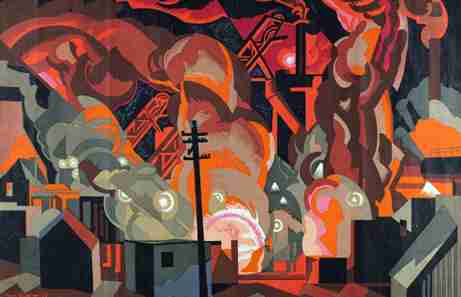
Image: Clive Arthur Gardener, A Blast Furnace (1927), Empire Marketing Board poster © Manchester City Galleries



Following the success of the first pan-Black Country Festival, Home of Metal, in 2011, the Black Country Museums Partnership presents the BLACK COUNTRY ECHOES FESTIVAL, celebrating the manufacturing heritage of the Black Country from the early 20th century to the present day, but with particular focus on the period since the second world war.
It will launch on 19 September 2014, with many exhibitions open until January 2015.
The region that still represents the greatest proportion of its population working in manufacturing in the UK, the Black Country has been responsible for the production of some of the world’s most ubiquitous products, from Chubb locks and Phoenix glassware kitchenalia, to the Queen’s handbags and the world’s lighthouse lenses, as well as the war-time production of TNT and cyanide, to many iconic cars – from the rare Swallow Doretti and the Frisky, to the Bean and the Jensen.
Exploring how this industrial heritage has shaped the built, social, cultural and economic landscape to create the distinctive character of the Black Country, the festival will bring to life this globally influential region and its communities, through a programme of arts and photography exhibitions, heritage days, tours and canal boat trips, film screenings, live music, vintage events and classic car weekends and much more besides.
Produced by WAVE, the Black Country Echoes Festival will see an official launch take place on 20 September 2014 and will bring together more than 25 venues around the region, taking in Wolverhampton, Walsall, West Bromwich, Bilston, Sandwell and Dudley. A select number of events will open earlier in September.
Taking the visions of Mordor in West Midlands raised J.R.R. Tolkien’s work as inspiration, the major exhibition ‘The Making of Mordor’, will explore links between the Black Country’s industrial landscape and Tolkien’s fantasy fiction at Wolverhampton Art Gallery.
Using Tolkien’s abhorrence of industry as a starting point, this exhibition explores a spectrum of artistic responses, from the early 1900s to present day, to the industrialisation of the Black Country and surrounding region, examining in particular the struggle for dominance between nature and industry.
Examples of Tolkien’s drawings and fictional visions will be presented alongside contemporary works byOlafur Eliasson, Richard Billingham, Euripides Altintzoglou, Brian Griffin and Tolkien and Game of Thrones illustrator Ted Nasmith, together with the earlier industrial visions of fantasy author Mervyn Peake, best known for his Gormenghast trilogy, but who also painted the glassblowers of Smethwick’s Chance Brothers factory; early 20th century artists Edward Wadsworth, Edwin Butler Bayliss and mid-20th century Clive Arthur Gardiner and Michael Ayrton.
Light House will present large-scale projections of the region’s extraordinarily rich photography archive, including rarely seen work by Nick Hedges, John Bulmer, Peter Donnelly and watercolour artist Arthur Lockwood, as well as the Jubilee Arts Archive. Including images of the evocative landscapes, iconic architecture and people connected to the factory life of the region, this diverse documentation particularly focuses on the manufacturing backdrop of the 1960s – 1990s
A region-wide film and cinema programme will also take place from September to December, including archive footage and newsreels documenting everything from manufacturing processes inside the region’s major factories, to the heavy metal and biker scenes of the area and visits to the Black Country by politicians and the Queen; to Ken Loach’s Spirit of ‘45 and cinematic blockbusters including The Lord of the Rings trilogy.
Emerging filmmaker Billy Dosanjh’s Year Zero: Black Country examines contemporary immigration in the Black Country, particularly focusing on Smethwick’s South East Asian communities. This film sits alongside a variety of activity, which examines the changing industrial workforce of the Black Country brought about through immigration, including, in recent times, the re-appropriation of former factories which have been repurposed in the region as religious buildings, in particular, Sikh and Hindu temples. The relationship between the old and new uses of these buildings is being explored through a local communities project and will result in a series of small exhibitions, with some buildings open to the public as part of a series of Heritage Open Days.
The legacy of pollution and more recent ‘re-greening’ of the Black Country will also be explored through an artist-led project by the collective MADE, focusing on the history of the River Tame, as well as ‘The Making of Mordor’ artworks such as Olafur Eliasson’s The Forked Forest Path, which has been created in association with Wolverhampton City Council’s urban regeneration team, representing the forest which was cut down to create Mordor; and Euripides Altintzoglou’s photographic series, which sees nature reclaiming its rightful place as it slowly infiltrates now defunct industrial space.
The festival will also see a special series of weekend events, including classic car shows, bringing together a host of rare, classic and collectible cars, motorbikes and buses manufactured in the Black Country; Dress Up Decades vintage events celebrating the local fashions, music and entertainment of the 40s to the 70s; art trails and history tours.
Using the term ‘Echoes’ to explore the way artists, writers and musicians have reflected on the area’s landscape and history, the Festival will also bring to life shared stories of the Black Country which reappear in the history and character of a series of individual towns in the area, as well as the way the ‘Black Country experience’ of mining and industry is repeated in different places in Europe, such as the Charleroi region of Belgium which is independently known as the ‘pays noir’. Artist Stanza will create a digital film, which, using footage from each place, will illustrate the linked history between the ‘Black Countries’ of Belgium, Poland and the UK, to be shown in galleries in the three countries consecutively.
Further exhibits and events will come to life through the Black Country History archive at www.blackcountryhistory.org, alongside a series of Heritage Open Days (September 2014) and a Family Arts Festival (October 2014 half-term).
A highly illustrated publication, Black Country Echoes: People, Landscape, Industry, Art will present a lively range of articles which consider the Black Country’s manufacturing history since the end of the second world war. It will be published in September 2014 to coincide with the festival’s launch.
For more information and to view the programme in full, please Click Here.

