

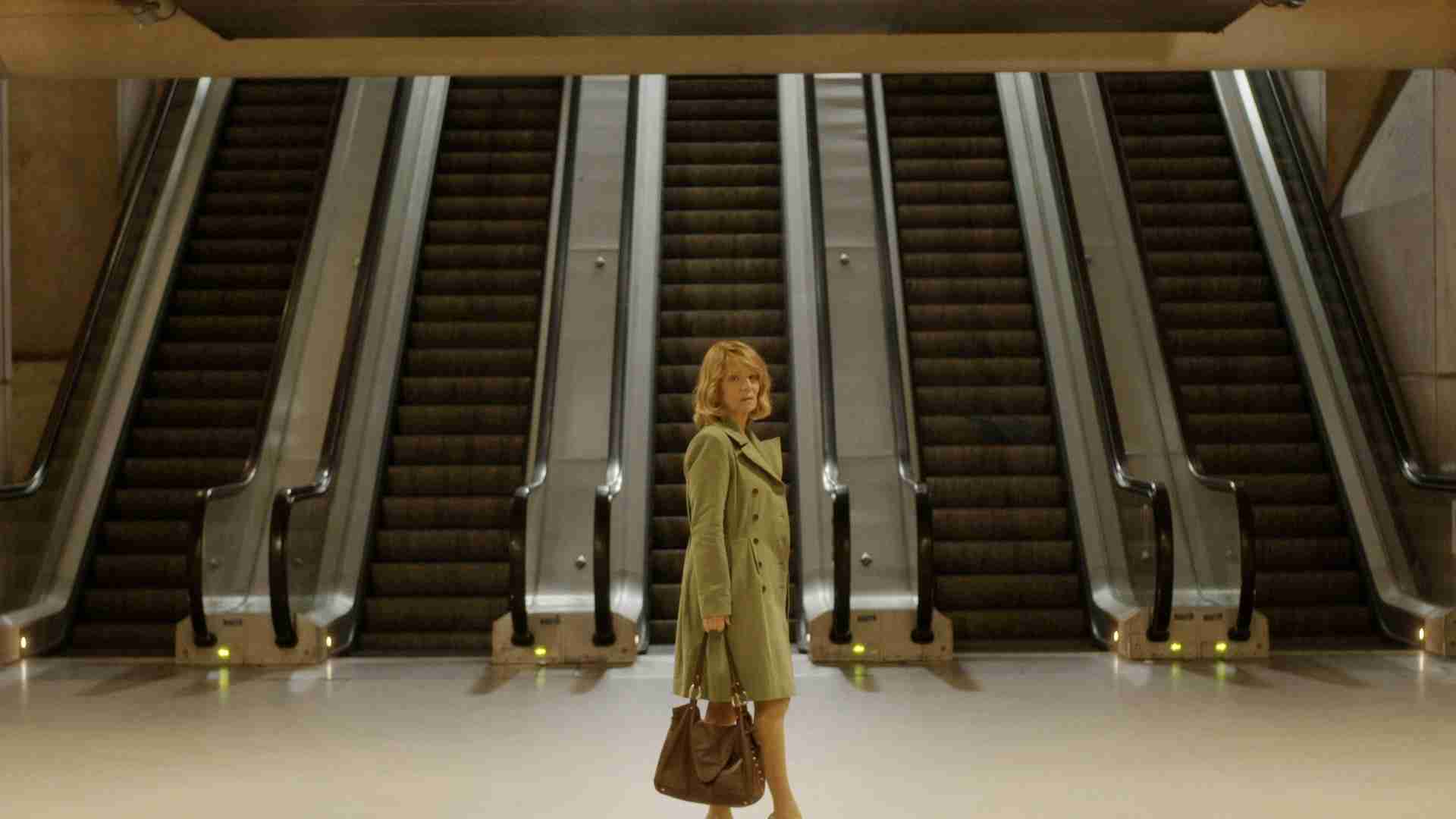

Gare du Nord
Les Films d’Ici / Claire Simon / 2013 / France-Canada
Running Time: 115 minutes (01:54:47)
Aspect Ratio: 1.85:1
Genre: Drama
Certificate: PG
Image: Colour
Language: French
Subtitles: English
——————————————————-

——————————————————-
Gare du Nord, Paris. People from all the multitudinous walks of life hurriedly intersperse and communicate in the cavernous and near labyrinthine confines of Europe’s busiest railway station – ‘a representation of the world’ as it is referred to early on in the film..
Through the colossal array of passengers inhabiting the station the film hones in on the exploits of four central characters, drifting repeatedly though the station’s myriad halls, and all loosely linked and connected through the eponymous Parisian railway terminus – but of course it is the station itself – the great ‘Gare du Nord’ – which remains the central character throughout the film.
When not researching his thesis (titled: ‘Gare du Nord: A Global Village Square’), young Algerian-born doctoral student, Ismaël (Reda Kateb) spends his time conducting satisfaction surveys for the Paris Transit Authority, in order to finance his studies.
Mathilde (Nicole Garcia), a former academic professor of social sciences, traverses the station every day in order to reach a clinic for her medical treatment.
During one of Ismaël’s aforementioned surveys, he comes across the path of the ailing Mathilde, and though she is clearly distressed, a connection begins to blossom, and the pair begin an unlikely romantic relationship, despite their notable age difference.
Coupled with the central relationship between Ismaël and Mathilde, we then have our two final protagonists: the desolate estate agent, Joan (Monia Chokri), struggling to be apart from her family and hoping her clients will show up at the scheduled time, and finally, Sacha (François Damiens), a renowned TV comic and presenter in search of his missing teenage daughter.
Best known for producing documentary feature films and documentary shorts, it is not surprising then that this fourth non-doucmentary feature film from director Claire Simon unfolds in a fairly conversational, docu-drama style.
The initial premise of Simon’s film may seem perfect as the basis of a traditional documentary feature, however in attempting to interweave what is on the whole a fairly loose and tentative fictional plot into the mix, the film does begin to lose clarity and focus, and what we are ultimately presented with is an almost discordant or perhaps disordered narrative structure.
I almost began to wish Simon had either dropped the fictional element altogether and instead concentrated on a straight documentary, or expanded her scope to incorporate a wider cluster of characters.
The four main characters at the heart of the piece are never really developed or explored enough to fully connect or empathise with them, and then entwined throughout their overlapping stories we have cameo appearances from other diverse characters who actually seem far more interesting and complex characters to explore.
At a running time of just under two hours the pacing does unfortunately begin to suffer, with the film often moving from its initial character study to take a more detached or observational look at events, and I have to say I did find my attention begin to wane slightly towards the latter stages.
Simon’s screenplay is thankfully quite involving, the cinematography is appealing and nicely achieved and the perfomances are very natural and authentic, adding a greater sense of dimension and depth to the (narratively) underdeveloped characters.
Simon does ultimately deliver an intriguing and fairly detailed collage of life within the restless station, and often paints quite a moving portrait of the nature of humanity, but there is greater opportunity to explore here, and the piece deserves a more coherent central narrative and a more striking finale.
——————————————————-
——————————————————-

