

Ida
Fandango Portobello / Paweł Pawlikowski / 2013 / Poland
Running Time: 80 minutes
Genre: Drama
Aspect Ratio: 1.37:1
Certificate: PG
Image: Black & White
Language: Polish
Subtitles: English
——————————————————-

——————————————————-
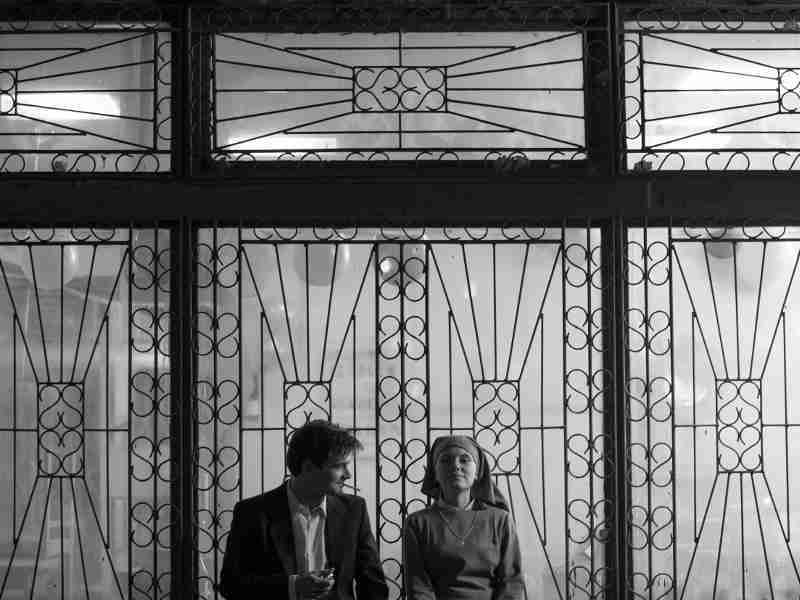
Much like Jahmil X.T. Qubeka’s controversial ‘Of Good Report‘, the first London Film Festival film reviewed here on the site, Paweł Pawlikowski’s haunting evocative ‘Ida’ once again proves a sparse, bleak and beautifully composed film, vividly shot in radiant black and white (here in the now rarely seen original square-frame Academy aspect ratio of 1.37:1), powerfully exploring some deeply profound issues that indubitably prove very personal to the director (and co-writer, Rebecca Lenkiewicz), and featuring an enigmatic and predominantly silent character at the centre of the piece.
Having left communist Poland at the age of just 14 to live in Germany and other European countries, before finally settling in the UK where he has produced his most acclaimed and best known work (including his debut feature film ‘Last Resort’ (2000) and the 2004 drama ‘My Summer of Love’), ‘Ida’ (winner of the Golden Lion, the top prize, at Poland’s 38th Gdynia Film Festival) sees the Warsaw-born filmmaker Paweł Pawlikowski returning to his native land for this intimate and affecting study of some of Poland’s more turbulent and antagonistic subjects and issues, most notably the controversial relationship between Polish Catholics and Polish Jews, the question of the significance of faith and the ultimate restrictions of religion.
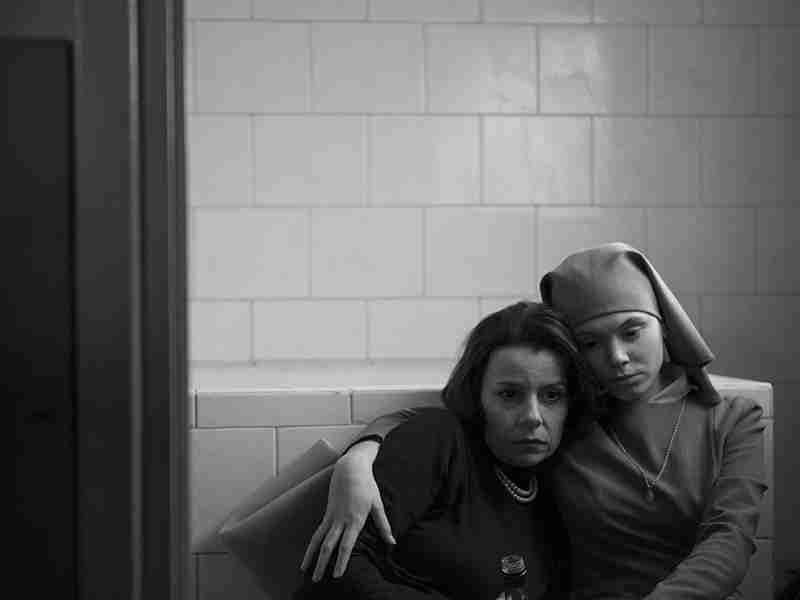
1962. Poland. Orphaned during World War II, and brought up in a convent, the young noviciate nun Anna (Agata Trzebuchowska) (on the verge of taking her vows) is informed by the Mother Superior that she must establish contact with her last remaining relative before she is fully accepted into the Catholic Church.
However, upon making contact with her last remaining relative – her indulgent, middle-aged aunt, Wanda Gruz (Agata Kulesza) (her mother’s sister, now working as a communist party judge) – the young nun unexpectedly discovers that her real identity is not Anna, but in fact Ida Lebenstein, born in Piaski (the first town in Poland where the Nazis established a ghetto in the spring of 1940) to Jewish parents Haim Lebenstein and Roza Herc, and alongside her aunt sets out on a journey to uncover the secrets and hidden truths of her family’s dark past.
Ida is ultimately a very contemplative and slow-burning piece which gently builds as the past familial truths are unveiled. Although the pacing is fairly slow and measured it never threatens to detract from the piece, and thanks to a bold script and clever narrative, the film only becomes gradually more compelling as the various aspects of the plot unfold.
Esoteric and well-controlled performances from the innocent, wide-eyed, 21-year old newcomer Agata Trzebuchowska, quite excellent in her debut role, and the experienced Agata Kulesza convey a great deal of subdued emotion, mystery and authenticity throughout, and nicely mirror the religious constraints the characters are ultimately forced to deal with.
Executed with acute understanding, ‘Ida’ proves an articulate and extremely impassioned work, very evocative of the time in which it is set, and imbued with a great sense of intimacy and humanity.
With welcome transcendental hints of Dreyer and Bresson, Pawlikowski’s expressive film proves a philosophical, reflective and subtly affecting work of great skill and precision.
Whilst we are on the subject of Carl Theodor Dreyer and Robert Bresson, the ethereal and often unusually framed black and white cinematography of Lukasz Zal is truly superb and distinctly recalls the work of the Belgian-born French cinematographer, Ghislain Cloquet, who shot Bresson’s ‘Au Hasard Balthazar’ (1966) and ‘Mouchette’ (1967), and the Danish cinematographer Henning Bendtsen, who shot Dreyer’s late masterpieces, Ordet (1955) and Gertrud (1964).
——————————————————-
——————————————————-
[youtube id=”MRzbCZtiWYc” width=”600″ height=”350″]


[…] Click Here to read our full review. […]